
The treated plants pulled ahead
On 1 February the two areas were still close. By 20 February the treated plants were clearly ahead — taller, thicker-stemmed, and holding far more of their fruit. The widest gap was in top-of-plant retention.
Twynam Agricultural Group — a major Australian cotton grower — ran a treated-vs-untreated trial on Sicot 289 RR2 at Collymongle Station, NSW, measured it twice as it grew, and carried it to harvest. Here is what they recorded.
“During the season, especially at the end of the crop life, we could see an increase in biomass of the treated area over the control. We took the trial through to harvest and saw a yield increase. Quality also appeared better. We did have some harvest & processing difficulties which will not allow us to guarantee the exact increase of the treated area over the control. We will be repeating this trial this summer on a larger area… as we were suitably satisfied that there was a response.”
Twynam Agricultural Group — one of Australia's largest cotton growers — set up the trial in the 2005–06 season at Collymongle Station, near Moree, NSW. A single field (No. 204, 3.44 ha) of Sicot 289 RR2 was split into a treated area and an untreated control, farmed the same way, measured by plant biometry on two dates as the crop grew, then carried to harvest and ginned.
On 1 February the two areas were still close. By 20 February the treated plants were clearly ahead — taller, thicker-stemmed, and holding far more of their fruit. The widest gap was in top-of-plant retention.
Picked and ginned from the same 3.44-hectare field, the treated area out-yielded the untreated control by 18.7% — and ginned out to a higher lint turnout.
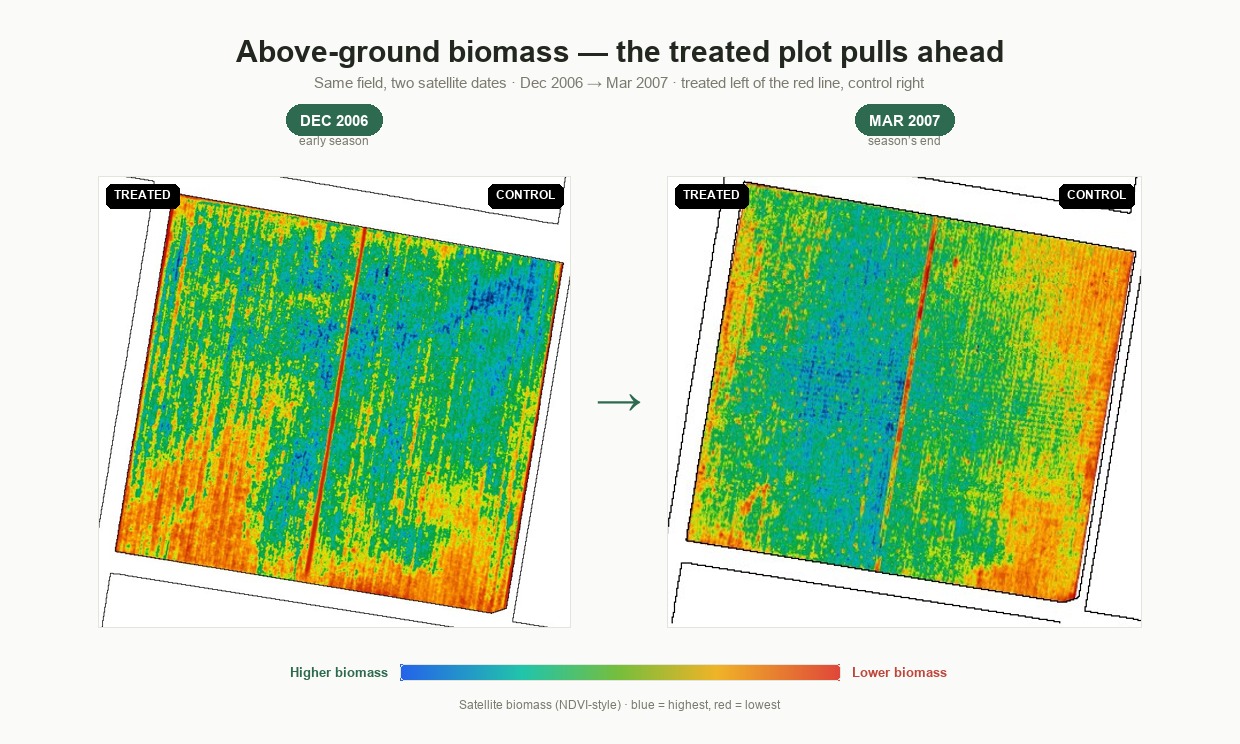
The grower repeated the trial the next season on a larger area, monitored through the crop by satellite biomass imagery. Blue marks the highest above-ground biomass, red the lowest; the red line splits the treated plot (left) from the untreated control (right). The record notes the treated plot moving from behind in December to ahead by season's end in March.
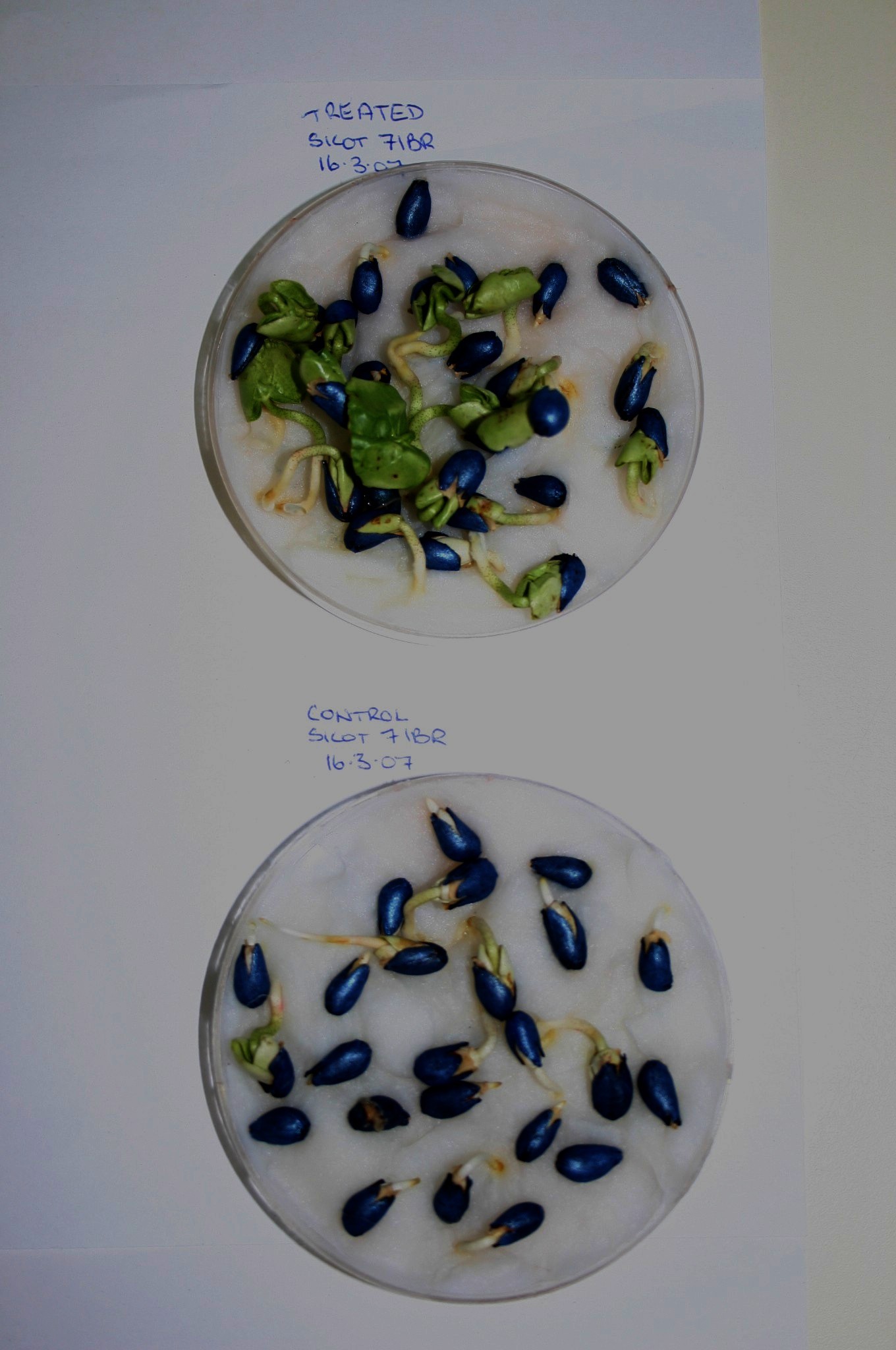
A separate germination test on a different Australian cotton — Sicot 71BR, at the Australian Cotton Research Institute in Narrabri (2007). By the fourth day the treated seed had pushed out green cotyledons while the untreated control was still mostly closed.
One treated field against one control field — not randomized or replicated — and the grower explicitly declined to guarantee the exact yield figure after harvest and processing difficulties. A candid, independent grower observation, not a controlled result.
Every figure here is a historical, third-party observation — not a guarantee. Run a control strip and let your own ground decide.